
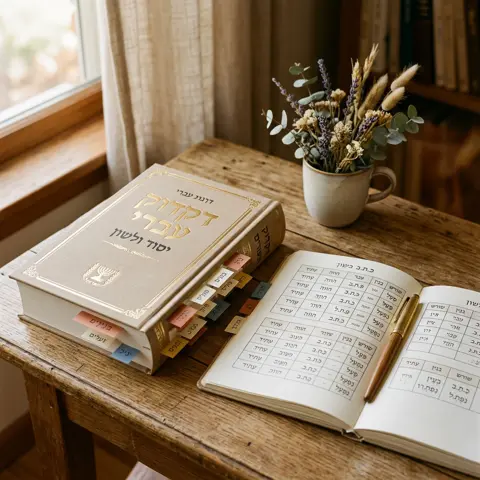
 Grammar Master
Intermediate
Hebrew Verb Conjugation Bible
Complete guide to all 7 verb structures (Binyanim) with practice exercises.
By Elisahar, native Hebrew speaker 7 min readUpdated November 4, 2026
Quick answer
Almost every Hebrew verb is built from a root of (usually) three consonants placed into one of 7 verb patterns called binyanim. The root carries the core meaning, and the binyan adds a nuance such as simple, intensive, causative, passive or reflexive. Once you know the 7 patterns, you can conjugate and often guess the meaning of verbs you have never seen.
Tap the speaker next to a Hebrew word to hear it. Words without a native recording yet use your device’s Hebrew voice.
A root (shoresh) is a group of usually three consonants that carries a basic idea. For example, the root כ-ת-ב (k-t-v) is about writing. It appears in כָּתַב katav (he wrote), מִכְתָּב mikhtav (a letter), כְּתוֹבֶת ktovet (an address) and הִכְתִּיב hikhtiv (he dictated). Learning to spot the root is the single most useful Hebrew skill after the alphabet.
| Binyan | Typical meaning | Example (past, he) |
|---|---|---|
| Pa’al (פָּעַל) | Simple, basic action | כָּתַב katav – he wrote |
| Nif’al (נִפְעַל) | Passive or "happening to" (of Pa’al) | נִכְתַּב nikhtav – it was written |
| Pi’el (פִּעֵל) | Intensive or active | דִּבֵּר diber – he spoke |
| Pu’al (פֻּעַל) | Passive of Pi’el | סֻפַּר supar – it was told |
| Hif’il (הִפְעִיל) | Causative (make someone do) | הִזְמִין hizmin – he invited / ordered |
| Huf’al (הֻפְעַל) | Passive of Hif’il | הֻזְמַן huzman – he was invited |
| Hitpa’el (הִתְפַּעֵל) | Reflexive or mutual | הִתְלַבֵּשׁ hitlabesh – he got dressed |
The same root in different binyanim gives related meanings. With the root ל-ב-שׁ (clothing): לָבַשׁ lavash (he wore, Pa’al), הִלְבִּישׁ hilbish (he dressed someone, Hif’il) and הִתְלַבֵּשׁ hitlabesh (he got dressed, Hitpa’el). Not every root appears in every binyan, and meanings are not always predictable, but the pattern gives you a strong clue.
In the present tense, learn the four forms of each binyan (masculine and feminine, singular and plural) first. You will use them constantly, and they are the easiest way to "feel" each pattern.
Prefer video? Watch more Hebrew lessons on the Hebrew With Elisahar YouTube channel.
Not sure where to start? Take the free level test.
Grammar MasterComplete guide to all 7 verb structures (Binyanim) with practice exercises.
Level Up 🚀Verb Conjugation Bible, Reading Without Nikud workbook and Everyday Conversations audio course.
 Grammar Pro
Smichut, passive binyanim, formal connectors and writing emails, essays and reports in polished Hebrew.